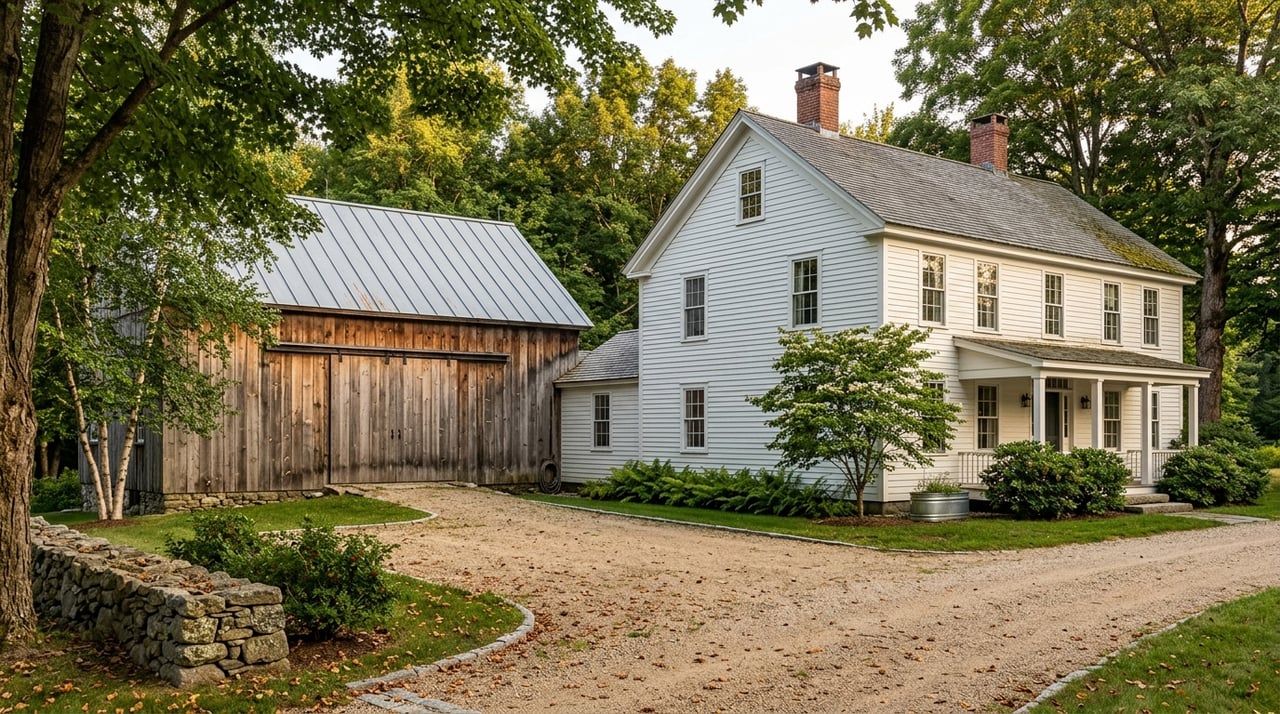
If you are dreaming about a Greene County country home with acreage, a barn, or a long view across fields, it helps to know that not all parcels work the same way. A house in a river town can raise very different questions than one in a valley or mountain setting, especially when slope, drainage, utilities, and outbuildings enter the picture. This guide will help you look past the romance and understand the practical basics that shape country properties here. Let’s dive in.
Greene County land is highly site-specific
Greene County’s country-property market is varied by design. County planning materials group the area into river towns and villages, valley towns, and mountain towns and villages, and they emphasize development that fits the natural topography, vegetation, drainage systems, and other site features.
For you as a buyer, that means two properties with the same acreage can live very differently. One parcel may be open and easy to access, while another may involve steeper grades, more clearing, or a longer list of utility and drainage questions.
County materials also frame land through water, biological, agricultural, recreational, and scenic resources. That is a useful way to think about country homes in Greene County, where the feel and function of a parcel often matter just as much as the house itself.
Land types you may encounter
Open fields and agricultural ground
Open land often appeals to buyers who imagine gardens, orchards, grazing areas, or simply broad views and sunlight. In practical terms, fields are often the easiest areas to evaluate for those uses, but the best use still depends on drainage, soils, and the parcel’s local context.
Greene County has one consolidated Agricultural District, and New York law protects and promotes land used for farming in those districts. The county also notes that farms help preserve rural character and open space, which is part of why some field parcels remain distinctly agricultural in feel.
If a property includes land in agricultural production, New York’s agricultural assessment program may reduce property taxes by valuing the land for agricultural use rather than full development value. That can be meaningful, but it also underscores the need to understand how the land is actually being used today.
Wooded parcels and mixed acreage
Wooded acreage offers a different kind of appeal. You may be drawn to privacy, trails, shade, or a sense of retreat, but a wooded lot is also a maintenance and environmental decision, not just a visual one.
Greene County’s natural-resource planning places strong emphasis on water, biology, recreation, and scenic resources. So when you evaluate wooded land, it helps to think beyond the acreage count and consider drainage patterns, access routes, selective clearing needs, and long-term upkeep.
New York State says timber harvesting itself does not require a state permit. Still, permit issues can arise if work crosses regulated streams or affects designated wetlands, so any clearing plan should be viewed through that lens.
Slopes, drainage, and long driveways
Some of Greene County’s most beautiful settings come with grade changes, winding access roads, and more complex drainage. County planning guidance specifically encourages design that works with natural contours to minimize clearing and grading.
That matters if you are looking at a home with a long driveway or envisioning a new access route to a barn, studio, or field. The key issue is rarely just driveway length. Grade, runoff, culverts, and any creek or wetland crossing can affect cost, maintenance, and approvals.
New York DEC general permits can apply to temporary access roads, culverts, bridges, and stream disturbances. So if a driveway interacts with drainage features, it is worth treating that as an early due diligence item rather than a later surprise.
In-town lots versus country parcels
A useful way to understand Greene County property differences is to compare in-town conditions with more rural ones. Catskill offers a clear local benchmark.
In the Town of Catskill, zoning districts have different minimum lot sizes, from 0.25 acre in certain districts to 1.5 acres in RA and 5 acres in Conservation. In the Village of Catskill, permits are required for many common projects, including storage sheds over 144 square feet.
The village also has a chicken and livestock law with a minimum lot size of one-half acre for chickens and two acres for other livestock. That makes the practical gap between an in-town lot and a country parcel very concrete.
Utilities can differ just as sharply. The Village of Catskill maintains separate water and sewer departments, while many rural properties rely on private wells and septic systems. You should always verify parcel-specific utility service rather than assume nearby municipal service reaches the property.
Barn basics: what matters most
What an agricultural building means
A barn may look simple from the outside, but its classification matters. New York defines an agricultural building as a structure designed and constructed to house farm equipment, farm implements, poultry, livestock, hay, grain, or other horticultural products.
The same guidance says an agricultural building cannot be a place of human habitation, a place where agricultural products are processed or packaged, or a place used by the public. That definition shapes how the building is treated under code.
Agricultural buildings are exempt from some construction and fire-code provisions, but not all operational, maintenance, or property-maintenance requirements. So even a classic working barn should never be treated as a no-rules structure.
When a barn becomes a bigger project
Many buyers picture a barn as future creative space. You may imagine a studio, workshop, guest area, or another flexible use that feels natural in a country setting.
This is where the details matter. If a barn is no longer used solely for agricultural purposes, its exemption may no longer apply, and the project can move into a much more regulated review path.
In short, a working barn and a converted barn are not treated the same way. If a property’s value to you depends on future conversion, that question should be explored early and carefully.
Sheds, garages, and accessory structures
Smaller outbuildings deserve attention too. New York notes that some structures under 144 square feet, such as tool sheds or storage sheds, may be exempt from the building-permit requirement, but that does not remove Uniform Code obligations.
Local law can also be stricter. In the Village of Catskill, for example, a storage shed over 144 square feet requires a permit, and the village states that permits are required for all new buildings and structures, garages, additions, and many other common projects.
If a property includes multiple outbuildings, it helps to review each one on its own terms. A garage, shed, or older secondary structure may seem minor, but its size, use, and local jurisdiction can all affect what comes next.
Tax treatment can depend on use
For buyers considering true farm use, there may be tax implications tied to how a structure is used. New York says agricultural structures and buildings may qualify for a ten-year property tax exemption if they are newly constructed or reconstructed and used for farming operations.
That exemption ends if the structure or land is converted to a non-agricultural or non-horticultural use. So if you are comparing a working farm building with a decorative outbuilding or future conversion project, use matters in more ways than one.
This is another reason to separate the aesthetic appeal of a barn from its legal and practical role on the property. In country real estate, romance and regulation often sit side by side.
Rural utility questions to ask early
Wells and septic systems
For rural properties, private utilities should be part of your first round of questions. New York State Health Department guidance says private wells should be tested at least once a year for bacteria and every three to five years for other contaminants.
The state also advises owners to keep records and maintain the system. On the septic side, state guidance says not to use a septic system if the surrounding soil is flooded.
These are not small details. If a home depends on private systems, understanding condition, maintenance history, and environmental context is part of understanding the property itself.
Wetlands, streams, and crossings
Water features can add beauty to a parcel, but they can also shape what is possible. New York DEC says a freshwater wetlands permit is required for physical disturbance within the boundary of a state-protected freshwater wetland or its adjacent area.
The DEC also notes that some local communities have their own wetland regulations. This becomes especially relevant when a long driveway, farm lane, culvert, or bridge interacts with drainage or stream features.
If a property’s access depends on a crossing, or if future improvements may touch wet areas, it is wise to understand that condition early. On country land, access and water are often deeply connected.
Neighboring uses matter in farm country
If a parcel sits near working farmland, you should expect a real agricultural setting. New York’s Agricultural Districts Law protects farmers against local laws that unreasonably restrict farm operations within agricultural districts.
Greene County’s own planning materials stress that farming helps preserve rural traditions, open space, and environmental quality. For buyers, that means neighboring land may continue to function as active farm ground rather than transition toward a quieter suburban pattern.
That context is not a drawback or a benefit by default. It is simply part of understanding place, which is essential when you are buying a country home for lifestyle as much as for square footage.
A simple Greene County checklist
Before you write an offer on a Greene County country home, try to confirm the basics at the parcel level:
- Municipality and local jurisdiction
- Zoning district
- Utility status, including well, septic, water, or sewer
- Wetland or stream constraints
- Driveway access, grade, and crossings
- Whether a barn or shed is an agricultural building, a standard accessory structure, or a likely conversion candidate
This kind of review is especially important in Greene County because rules and physical conditions can change quickly across town, village, and landscape boundaries. A property that photographs beautifully can still require a very practical reading.
For design-minded buyers, that is part of the appeal. The best country properties offer not just atmosphere, but a clear relationship between house, land, and outbuildings that makes sense for how you actually want to live.
If you are weighing a Greene County farmhouse, barn property, or mixed-acreage retreat, thoughtful guidance can help you read the landscape as carefully as the architecture. To explore the Hudson Valley and Catskills with a more informed eye, connect with Annabel Taylor.
FAQs
What should you verify before buying a Greene County country home?
- Confirm the municipality, zoning district, utility status, wetland or stream constraints, driveway access, and how any barn or shed is classified.
How do Greene County parcels differ by location?
- County planning groups the area into river, valley, and mountain settings, and those differences can affect slope, access, clearing, drainage, and land-use patterns.
What counts as an agricultural building in New York?
- An agricultural building is designed and constructed to house farm equipment, implements, poultry, livestock, hay, grain, or other horticultural products, and it cannot be used for habitation, public use, or product processing and packaging.
Why does barn use matter when buying a Greene County property?
- A barn used only for agricultural purposes may be treated differently under code than a barn planned for a studio, guest space, workshop, or other non-agricultural use.
What utility issues should you review on a rural Greene County property?
- You should verify whether the property relies on private well and septic systems or municipal service, and review maintenance records, testing history, and parcel-specific conditions.
Why do wetlands and streams matter on Greene County land?
- Wetlands, streams, culverts, bridges, and access roads can affect permits, approvals, costs, and how you use or improve the property.
Can agricultural use affect property taxes on Greene County land?
- Yes. New York’s agricultural assessment program may reduce taxes on land in agricultural production, and certain agricultural structures may qualify for a ten-year property tax exemption if they meet state requirements.